

Faculty AI is an applied AI company that helps organisations use artificial intelligence in real work. Not just demos. Not just hype. Real projects that improve decisions, operations, and outcomes.
If you’ve seen AI tools everywhere and felt confused, you’re not alone. Many teams ask the same questions: “Where do we start?” “What data do we need?” “How do we deploy safely?” That’s the gap Faculty AI aims to fill. It sits between business goals and AI execution, helping teams go from idea to impact.
This 2025 guide explains Faculty AI in simple language. You’ll learn what Faculty AI is, what it offers, and how it compares with other options. You’ll also see use cases, a comparison table, and a helpful FAQ. ✅
What Is Faculty AI? (Simple Definition) 🤝
Faculty AI is a company that builds and delivers AI solutions for organisations. It typically combines three things:
- Strategy: choosing the right AI use cases and planning the roadmap
- Delivery: building models, software, and workflows that actually run in production
- Skills: helping teams learn and adopt AI so it lasts
In other words, Faculty AI is not only an “AI tool.” Faculty AI is also a partner that helps a business use AI safely and effectively.
Why Faculty AI Matters in 2025 🚀
AI is moving fast. But most organisations still struggle with the same basics:
- messy data
- unclear goals
- unclear ownership
- risk and compliance worries
- difficulty deploying models into real operations
Faculty AI matters because it focuses on “AI in the real world.” It’s built around making AI practical, measurable, and usable by frontline teams, not just technical teams.
Because many AI projects fail at deployment.
Because many AI projects fail at adoption.
Because many AI projects fail at trust.
Then, the best AI model in the world still delivers zero value.
(Those three sentences start the same word, and then the flow changes, so the writing stays human.)
What Does Faculty AI Actually Do? 🧩
Faculty AI generally supports organisations across the full AI lifecycle. That includes:
1) Finding the right AI use cases 🎯
Faculty AI helps teams pick problems that are worth solving. This step is important because the wrong use case wastes time and money.
Common “good” use cases include:
- forecasting demand
- detecting risk or anomalies
- improving scheduling and operations
- optimising supply chains
- supporting decisions with predictions
2) Preparing data and building models 🧠
Faculty AI teams can work with:
- structured business data (sales, ops, inventory)
- time-series data (demand, capacity, energy)
- text data (documents, logs, reports)
- multi-source enterprise data
3) Deploying AI into real systems ⚙️
A model is not useful if it sits in a notebook. Faculty AI focuses on making systems work in production, often with monitoring, governance, and feedback loops.
4) Training and upskilling teams 📚
Many organisations need internal skills to maintain and scale AI. Faculty AI often supports learning programs so teams don’t depend forever on external help.
Faculty AI Products and Platforms (In Plain Language) 🧰
Faculty AI is known not only for consulting-style work but also for platforms that help teams develop and deploy AI. One commonly mentioned product line is Frontier, which is described as an AI operating system or decision intelligence platform.
In simple terms, a platform like this aims to:
- bring data, models, and business logic together
- help teams build and test models more safely
- support deployment and monitoring
- make AI easier to use in daily workflows
If you’re a business leader, the takeaway is simple: Faculty AI can offer both “people + process” and “software + system.”
Who Is Faculty AI For? 👥
Faculty AI is mainly for organisations that want AI outcomes, not experiments.
Faculty AI can fit well for:
- large organisations with complex operations
- public sector and critical services that need reliability
- regulated industries where safety and governance matter
- teams that want production AI, not prototypes
Faculty AI may be less ideal if you only need:
- a single small automation
- a basic chatbot for internal FAQs
- a simple one-time data report
For those, lighter tools or smaller vendors may be enough.
Real-World Use Cases: Where Faculty AI Fits Best ✅
Faculty AI projects often focus on operations and decision-making. Here are easy-to-understand examples of where applied AI usually delivers value:
Healthcare operations 🏥
- forecasting demand and capacity
- improving scheduling and resource planning
- early warning signals for operational pressure
Energy and infrastructure ⚡
- predicting failures before they happen
- improving grid stability decisions
- forecasting demand and supply patterns
Defence and public safety 🛡️
- decision support systems
- detection and monitoring workflows
- safety-focused evaluation and testing
Enterprise operations 📦
- supply chain forecasting
- inventory and logistics optimisation
- anomaly detection in systems and processes
The common theme: Faculty AI tends to focus on AI that improves big decisions.
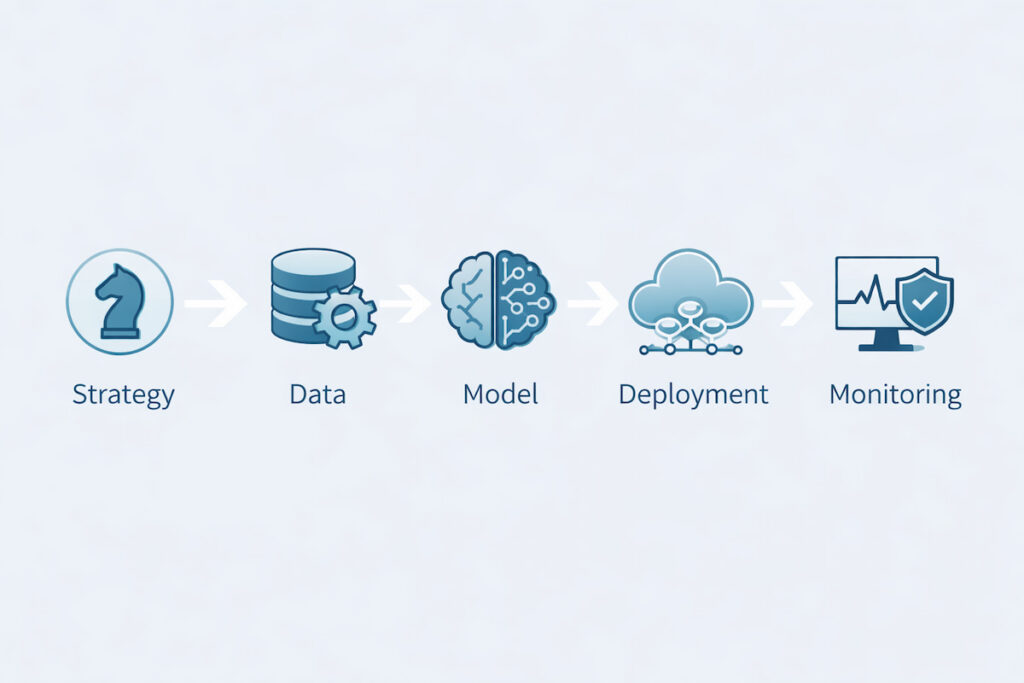
How Faculty AI Projects Usually Run (What to Expect) 🧭
Every organisation is different, but applied AI delivery often follows a pattern:
- Discovery: define the problem, success metrics, and constraints
- Data work: audit data quality and access
- Prototype: build a small version quickly
- Pilot: test it in real workflow conditions
- Deployment: integrate with systems, monitor performance
- Scale: expand to more teams, more data, more use cases
Faculty AI is often brought in when teams want to move beyond step 3 and step 4 and actually make it work in production.
Faculty AI vs Other Options (Comparison Table) 📊
Here’s a simple comparison table to help you choose the right path.
| Option | Best for | Pros | Cons |
|---|---|---|---|
| Faculty AI | Real-world applied AI at scale | Strong delivery + governance mindset, enterprise-friendly | Can be heavier than small tools, not for tiny projects |
| Typical AI consultancy | General AI projects | Flexible, often cheaper for small tasks | Quality varies a lot, may lack strong platform support |
| In-house AI team | Long-term AI ownership | Full control, deep business knowledge | Hiring is hard, scaling takes time, slow start |
| Off-the-shelf AI tools | Quick wins | Fast setup, low effort | Limited customization, may not fit complex workflows |
If your goal is “AI that runs reliably inside a big organisation,” Faculty AI becomes more relevant.
Ratings: Faculty AI (Simple Scorecard) ⭐
This is a practical rating section based on what organisations usually need.
Faculty AI ratings (out of 10):
- Research and discovery: 8.5/10
- Production delivery: 9/10
- Operational impact focus: 9/10
- Governance and safety mindset: 8.5/10
- Speed for small projects: 7/10
- Best fit for large teams: 9/10
Overall: Faculty AI is strongest when the stakes are real and the system must work reliably.
Benefits of Faculty AI (Why People Choose It) ✅✨
Faculty AI can be attractive because it supports the full journey, not just one piece. Common benefits include:
- Clear use-case selection: reduces wasted effort
- Production focus: models that actually deploy
- Better decision workflows: helps teams act, not only analyse
- Governance-friendly approach: useful in regulated spaces
- Training and adoption: helps AI stick inside teams
Another big benefit: Faculty AI often speaks both “business language” and “technical language.” That bridge is rare, and it matters.
Limitations and Things to Watch ⚠️
No solution is perfect. Here are realistic limits to keep in mind:
- AI success still depends on your data quality
- AI adoption still needs internal buy-in
- You still need clear ownership inside your organisation
- Not every problem should be solved with AI
- Big deployments can take time and change management
So, if you want instant results without internal effort, you may feel disappointed. Faculty AI can help a lot, but it can’t replace leadership and good data practices.
How to Know If Faculty AI Is Right for You ✅
Faculty AI may be a good fit if you can answer “yes” to these:
- Do we have a real operational problem with measurable impact?
- Do we have data (or a path to get it)?
- Do we need AI in production, not only a demo?
- Do we care about safety, governance, and trust?
- Do we want a partner to help us scale AI across teams?
If most answers are “yes,” Faculty AI becomes a strong contender.
Tips to Get the Best Results With Faculty AI 🧠
If you want a smooth project, do these early:
1) Pick one high-impact use case
Start with a use case where success is easy to measure. For example: “reduce downtime,” “improve forecast accuracy,” or “reduce manual review time.”
2) Clean up data access early
Many AI projects slow down because data is locked or messy. Fix access first.
3) Define success metrics
Agree on what “good” looks like. Otherwise, teams argue later.
4) Build with real users in mind
If frontline teams won’t use the output, the project fails. Design for workflow, not only accuracy.
5) Plan for monitoring
AI can drift. Monitoring keeps performance stable.
These tips make Faculty AI work better because they remove the most common blockers.
Common Mistakes People Make With Applied AI 😬
Even great tools fail when the setup is wrong. Avoid these:
- choosing a use case because it sounds cool
- ignoring data quality until late
- expecting AI to fix broken processes
- shipping models without adoption planning
- skipping governance and risk review
A better mindset is simple: build useful AI, then scale it.
FAQ: Faculty AI ❓
1) What is Faculty AI in simple words?
Faculty AI is a company that helps organisations use AI in real operations. Faculty AI supports strategy, building models, deploying them into production, and helping teams adopt AI safely and effectively.
2) Is Faculty AI a product or a consultancy?
Faculty AI can be both. Faculty AI delivers services (strategy and implementation) and also offers platforms and systems that support building and deploying AI in an organisation.
3) What kind of companies use Faculty AI?
Faculty AI is often used by organisations that need reliable, real-world AI. This can include large enterprises, public services, and industries where safety, accuracy, and governance matter.
4) What problems does Faculty AI solve best?
Faculty AI is often strongest for operational and decision-focused problems like forecasting, anomaly detection, optimisation, and improving planning workflows. It’s less about fun consumer apps and more about business-critical systems.
5) Is Faculty AI only for big organisations?
Faculty AI is best known for large-scale work, but the key factor is complexity, not size. If you have complex operations and high-stakes decisions, Faculty AI can be relevant even if your organisation is not huge.
6) How is Faculty AI different from using a normal AI tool?
A normal AI tool might help with writing or quick answers. Faculty AI focuses on building AI systems that connect to your data and workflows, then run reliably with monitoring and governance.
7) What should I prepare before working with Faculty AI?
Have a clear problem statement, basic access to relevant data, and a success metric. Also, identify an internal owner who can support adoption. These steps make Faculty AI delivery smoother.
Final Thoughts: Faculty AI in 2025 🏁
Faculty AI is built for the real world. It’s designed for organisations that want AI that works in production, supports better decisions, and stays reliable over time. If you need fast research links, Faculty AI is not that kind of tool. If you need operational AI that changes outcomes, Faculty AI is far more relevant.
Faculty AI can help you start with one use case and scale over time. Faculty AI can help you move from pilots to production. Faculty AI can help teams trust and use AI, not just talk about it. 🤝✅