
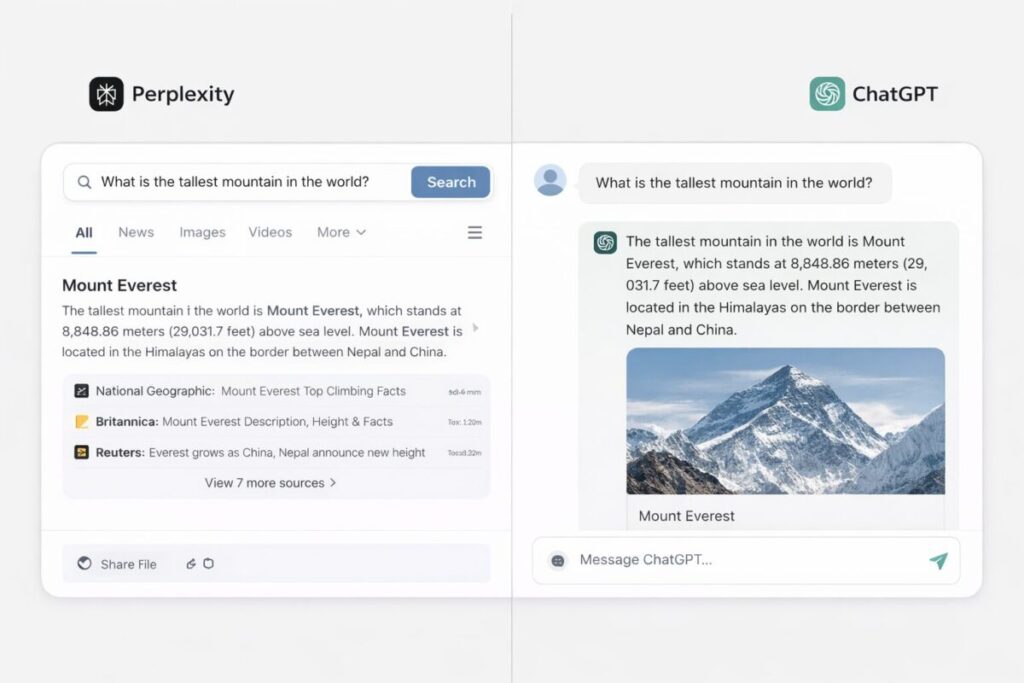
If you’ve been typing “Is Perplexity AI Good Enough to Replace ChatGPT in 2026?” into Google, I get it. AI tools are everywhere now, and nobody wants to waste time switching between apps if one can do it all. I also wanted a clear answer, not marketing talk, not fanboy opinions, and definitely not “everything is perfect” hype.
So I used both tools like a normal person. I asked quick questions. I tested long writing. I tried study notes. I tried planning. I tried rewriting. And after doing that, I realized something simple: both are strong, but they are strong in different ways.
Perplexity feels like a supercharged search assistant.
ChatGPT feels like a flexible creative partner.
The “replace” decision depends on what you actually do daily.
Let’s break it down in a clear and human way. ✅
What Perplexity AI does best in 2026 🚀
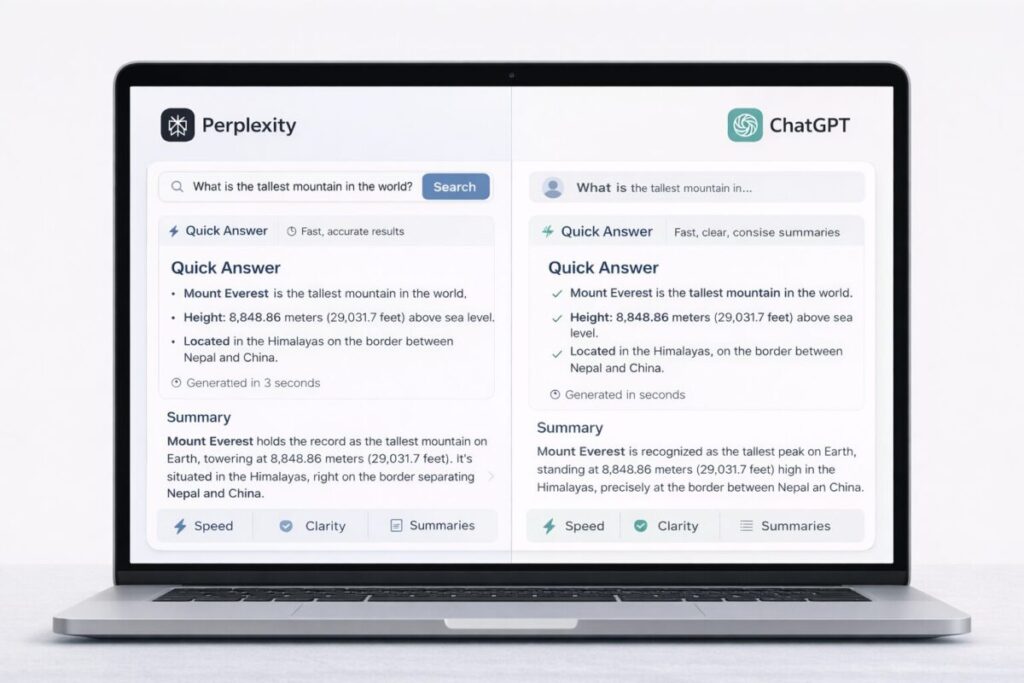
When I open Perplexity, my mindset is usually: “I need a clean answer fast.” And for that, it performs really well.
Fast research that’s easy to scan 👀
Perplexity often gives a neat, structured response that I can skim quickly. That sounds small, but it saves time.
- Quick summaries
- Simple comparisons
- Clear bullet-style breakdowns
- Less fluff, more direct answers
If you hate long paragraphs, you’ll probably like Perplexity.
Great for “what’s new” style topics 🗓️
Whenever the question is about what’s happening “right now,” Perplexity feels more natural because it behaves like research-first AI. In 2026, that matters a lot because AI tools change fast.
Helpful for students and quick learning 📚
Perplexity is also strong when you want quick learning without feeling overwhelmed.
- Simple definitions
- Short explanations
- Quick examples
- Easy notes you can revise later
If your goal is “understand it fast,” it’s excellent.
Where ChatGPT still feels stronger in 2026 💡
ChatGPT is still the tool I open when I want to produce something. Not just answer something.
Better long-form writing ✍️
When I want a blog post, script, or a polished piece of content, ChatGPT usually feels smoother.
- Better flow
- More natural transitions
- Better tone control
- More “human” sounding writing
Perplexity can write long content too, but ChatGPT tends to feel more consistent.
Better brainstorming and creativity 🧠✨
If I ask for 20 hooks, 10 intro ideas, or 15 content angles, ChatGPT usually gives more variety. It’s easier to push it for fresh ideas.
Better step-by-step workflows ✅
ChatGPT is stronger at structured “do this, then this” guidance.
For example:
- content calendars
- YouTube scripts with scenes
- study plans
- SEO structure
- rewriting to a specific style
That “project support” is where ChatGPT shines.
The biggest difference in real life (simple explanation)
This is the easiest way I explain it:
Perplexity helps me find answers faster.
ChatGPT helps me create better outputs.
Perplexity helps me research.
ChatGPT helps me build.
And that’s why replacement is tricky. If you only need research, Perplexity can be enough. If you need a creator partner, ChatGPT still holds value.
Is Perplexity AI Good Enough to Replace ChatGPT in 2026? (My honest answer)
Here’s my honest answer: Yes for some people, no for others.
Perplexity can replace ChatGPT if your daily tasks look like this:
- quick questions
- comparisons
- learning basic concepts
- summarizing content
- checking “what’s new” topics
However, Perplexity may not replace ChatGPT if you do things like:
- write blogs often
- write scripts often
- build content systems
- need tone and style control
- want deep creative brainstorming
So the replacement depends on your routine, not on hype.
Real-life replacement test (the way I judged it) 🔥
Here are common tasks and which tool felt better to me.
1) “Give me a quick answer”
Perplexity feels made for this.
Winner: Perplexity ✅
2) “Write a 2000-word blog that feels human”
ChatGPT feels stronger for flow and voice.
Winner: ChatGPT ✅
3) “Turn this topic into study notes”
Perplexity is clean and fast.
Winner: Perplexity ✅
4) “Rewrite this in my tone”
ChatGPT adapts better.
Winner: ChatGPT ✅
5) “Plan a complete workflow”
ChatGPT usually keeps the bigger picture.
Winner: ChatGPT ✅
That’s why I say Perplexity can replace parts of ChatGPT, but not always the whole experience.
A quick warning: replacement can reduce quality 😅
Sometimes people switch tools and think it’s fine because everything still sounds “smart.” But later they realize the results feel more generic or less creative.
Because at the start, everything feels impressive.
Because at the start, every answer seems correct.
Because at the start, you don’t notice small weaknesses.
Those small weaknesses show up when you do long projects.
Pros and cons (easy view) ✅⚠️
Perplexity pros ✅
- fast research
- clean, structured answers
- great for quick learning
- great for short comparisons
- less fluff
Perplexity cons ⚠️
- long writing can feel less “personal”
- less control over creative voice
- not as strong for deep workflows
ChatGPT pros ✅
- better long-form writing
- better creativity and brainstorming
- better tone control
- better for workflows and planning
ChatGPT cons ⚠️
- sometimes takes more guiding
- can feel slower for quick research
- can give extra info when you want short answers
My opinion section (honest and not biased) 🧩
If I had to pick only one tool in 2026, I would pick based on what I do most.
If I mostly research and compare things, I would choose Perplexity. It gives clean answers fast, and that saves time daily.
But if I mostly create content—blogs, scripts, plans, writing—then I would choose ChatGPT. It feels like a co-writer, not just an answer bot.
In real life, I don’t think it’s a “one must win” situation. I use Perplexity for research and quick clarity. Then I use ChatGPT for final writing, tone, and structure. That combination gives me speed and quality.
And to me, that’s the smartest way to use AI in 2026.
Ratings (my personal scorecard) ⭐
Here’s my no-bias rating:
- Research speed: Perplexity 9/10 | ChatGPT 7.5/10
- Long-form writing: Perplexity 7/10 | ChatGPT 9/10
- Brainstorming: Perplexity 7.5/10 | ChatGPT 9/10
- Study notes: Perplexity 9/10 | ChatGPT 8.5/10
- Step-by-step planning: Perplexity 7.5/10 | ChatGPT 9/10
- Overall “replacement potential”: Perplexity 8/10 | ChatGPT 8.5/10
So yes, Perplexity is close. But ChatGPT still wins in creation-heavy work.
Who should replace ChatGPT with Perplexity in 2026 ✅
Perplexity might be enough for you if you are:
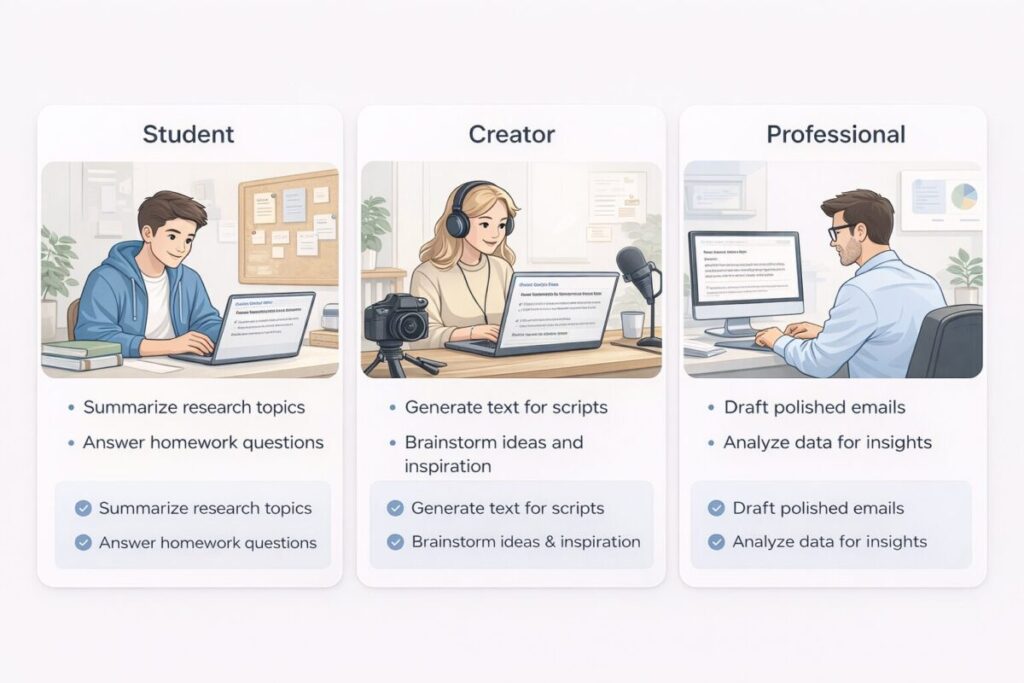
- a student who needs quick notes 📚
- someone who mostly researches
- someone who wants short answers
- someone who prefers scan-friendly output
- someone who doesn’t care about writing style
If that’s your profile, replacing ChatGPT is realistic.
Who should keep ChatGPT in 2026 ✅
You should keep ChatGPT if you are:
- a blogger or writer ✍️
- a YouTube script creator 🎥
- a marketer building content systems
- someone who needs tone and personal voice
- someone who wants deep project support
If you build things, ChatGPT still feels more complete.
FAQ (explained clearly) 🙋♂️
1) Is Perplexity AI good enough to replace ChatGPT in 2026?
Perplexity AI can replace ChatGPT for users who mainly need quick answers, research, and summaries. If your daily tasks involve asking direct questions, checking comparisons, or understanding topics fast, Perplexity works very well. However, if you regularly write long content, plan projects, or need creative help, ChatGPT still feels more complete. So the replacement depends on how you personally use AI.
2) Is Perplexity AI better than ChatGPT for students?
For students who want fast explanations, clean notes, and quick understanding before exams, Perplexity AI is very helpful. It breaks information into small, readable parts. On the other hand, ChatGPT is better when students need help writing essays, improving grammar, or explaining concepts in more depth. Many students may benefit from using both instead of choosing only one.
3) Can Perplexity AI replace ChatGPT for blogging and content writing?
Perplexity AI is useful for research, topic understanding, and outlining blog ideas. It helps you gather information quickly. But when it comes to writing full blog posts that sound human, emotional, and well-structured, ChatGPT usually performs better. Bloggers who care about tone, storytelling, and flow may still prefer ChatGPT for final drafts.
4) Which AI tool is better for daily productivity tasks?
If your daily work involves quick questions, checking facts, or summarizing information, Perplexity AI is very efficient. It saves time and reduces reading effort. If your productivity tasks include planning schedules, writing emails, creating content, or building workflows, ChatGPT feels more flexible and helpful. The better tool depends on whether your work is research-focused or creation-focused.
5) Should I use Perplexity AI and ChatGPT together in 2026?
Yes, using both together can be a smart choice. Many users prefer Perplexity AI for fast research and quick clarity, then switch to ChatGPT for writing, planning, and polishing content. This combination improves speed and quality at the same time. Instead of replacing one tool, combining them often gives the best overall experience.