

AI content creation tools can feel like a cheat code. You type a prompt, and suddenly you have a blog draft, a script, a thumbnail idea, and even captions. When you’re a beginner, that feels magical.
But after you use AI for a while, you notice something else: the “invisible limits.” These are not always obvious on day one. They show up after your fifth blog post. They show up when your audience doesn’t engage. They show up when the output sounds the same every time.
In this post, I’m sharing the hidden limitations of AI content creation tools I think every creator should know. I’ll keep it simple, human, and practical. I’ll also include tool examples and the specific limitations you might face with each one.
Because AI can help. Because AI can mislead. Because knowing limits helps you win. ✅
Why creators get surprised by AI content creation tools 😅
The surprise happens because AI is fast. When something is fast, we trust it too quickly. We assume speed equals correctness. We assume clean writing equals high quality. We assume a confident tone equals truth.
That’s where problems start.
AI is not “bad.” It’s just not human. And it has patterns. Once you see the patterns, you can use AI smarter.
Tool examples + their common limitations (quick list) 🧩
Here’s a simple, honest view:
- ChatGPT / Claude (writing): can be generic, can repeat ideas, can guess facts
- Gemini / Copilot (writing): can be great for quick summaries, but voice can feel “neutral”
- Jasper / Copy.ai (marketing): strong templates, but can feel salesy if you don’t control tone
- Midjourney (images): high-quality, but consistency needs practice
- Leonardo (images): flexible, but outputs can vary by model
- Canva (design): easy, but templates can look common if overused
- CapCut (video): fast, but template-style edits can feel similar
- Descript (video/audio): powerful, but needs learning for best results
- ElevenLabs (voice): great, but you still need script pacing and edits
Notice the pattern: AI gives you speed, but you still need taste.
Hidden limitation #1: AI often sounds “smooth” but not “real” 🧼
AI content creation tools are great at sounding confident. They can produce neat paragraphs, perfect grammar, and clear headings. However, sometimes the content feels like:
- too polished
- too generic
- too safe
- too “same same”
A human reader can sense that. They may not explain it, but they feel it. That’s why you might see low engagement even if the writing looks correct.
What I do to fix it
- I add personal opinion and small real examples
- I use short punchy lines
- I keep some imperfect human rhythm
- I write “what I would do” instead of “what people should do”
Hidden limitation #2: Repetition sneaks in (even when it looks different) 🔁
AI can repeat ideas in different words. It looks like new content, but it’s the same point again. This happens a lot in long-form writing.
Because it rephrases.
Because it expands.
Because it circles back.
You might not notice while writing. But readers feel it. They scroll faster. They leave.
Fix
- Ask AI to write fewer sections, but deeper examples
- Add a “So what?” line after each section
- Remove filler sentences aggressively
Hidden limitation #3: “Originality” is weaker than it looks 🎭
AI can generate ideas, but it often combines common patterns. That’s fine for learning. But if you rely on AI for every creative decision, your content starts to look like everybody else’s content.
This hits hard in:
- listicles
- tool roundups
- generic how-to posts
- motivational content
Fix
- Add one unique angle: your workflow, your checklist, your mistakes
- Use “one story” in every post
- Include one visual that is truly your style (thumbnail style, chart, or custom infographic)
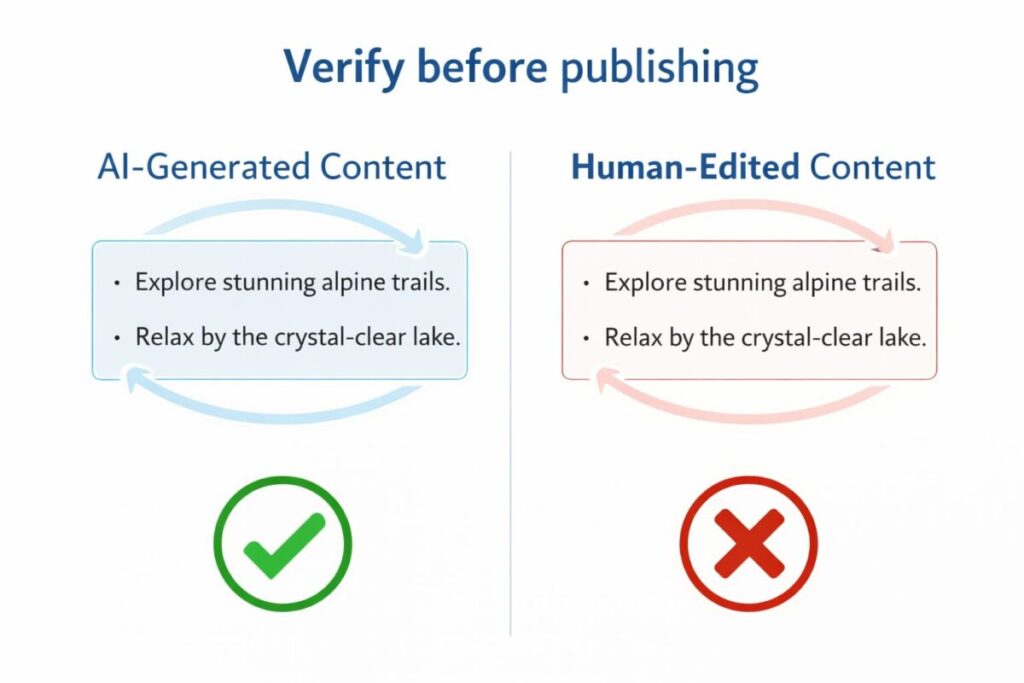
Hidden limitation #4: AI can be wrong in a confident way 😬
This is one of the most dangerous limitations. AI can sound sure even when it’s guessing. This is especially risky for:
- prices
- product features
- policies and safety rules
- current events
- “best in 2026” claims
Fix
- Avoid hard claims unless you verified them
- Write with soft language when unsure (“often,” “usually,” “in many cases”)
- Use your own testing notes when possible
- For tool prices, say “typical pricing” instead of exact numbers if you’re not sure
Hidden limitation #5: AI struggles with consistent brand voice 🎯
Many AI content creation tools can copy tone in one response. But keeping the same voice across 20 posts is harder. Beginners often end up with:
- one post sounding formal
- another sounding casual
- another sounding robotic
Readers notice inconsistency. It weakens your “brand.”
Fix
- Create a simple voice guide:
- “friendly, simple, short sentences, a little playful”
- Reuse a “brand prompt” at the start of every post
- Keep a few repeating phrases and sections (like “My opinion,” “Quick checklist,” “FAQ”)
Hidden limitation #6: AI doesn’t understand your audience deeply 👥
AI can guess what beginners want. But it doesn’t know your real audience unless you tell it. If you don’t define the audience, the content becomes “for everyone,” and content for everyone usually reaches no one.
Fix
- Define one audience every time:
- “Beginners who want to grow a blog”
- “Small creators making reels”
- “Students writing assignments”
- Add one sentence: “Explain like I’m new.”
Hidden limitation #7: AI can over-optimize and ruin readability 📉
This is common in SEO writing. People force keywords and headings, and the content becomes stiff. The reader feels like they’re reading a robot manual.
If you want good SEO, you still need good human flow.
Fix
- Use keyword naturally (not everywhere)
- Use shorter sentences
- Use transitions like “however,” “also,” “so,” “now,” “here’s the catch”
- Add bullets and quick summaries
Hidden limitation #8: Image tools can’t guarantee consistent characters 🎨
If you use AI image generation for YouTube thumbnails or character-based stories, you may notice consistency problems:
- face changes
- outfits change
- background changes
- style changes
Example tools
- Midjourney: amazing style, but character consistency can be tricky without careful workflows
- Leonardo: flexible styles, but outputs can vary by model/preset
- Bing Image Creator: fast and easy, but limited fine control
Fix
- Use the same prompt structure each time
- Save your best prompt as a template
- Use reference images where possible
- Keep the “main character description” locked
Hidden limitation #9: Video tools can create “cookie-cutter” edits 🎥
AI video tools are great for speed. But sometimes they produce edits that look like everybody else. That can reduce brand identity.
Example tools + limitation
- CapCut templates: fast, but your videos can look like template clones
- Auto caption tools: helpful, but can place captions awkwardly
- Repurposing tools: choose clips, but may miss emotional moments
Fix
- Use templates as a base, then customize:
- font style
- caption placement
- your hook style
- your signature transition
Hidden limitation #10: Audio tools can sound “too perfect” or “too fake” 🎙️
AI voiceovers are improving, but beginners sometimes face:
- unnatural emotion
- weird pauses
- robotic stress on words
Example tools
- ElevenLabs: strong voices, but still needs direction and editing
- Basic TTS tools: easy, but often sound generic
Fix
- Keep sentences short
- Add punctuation for pacing
- Use light background music to mask tiny robotic edges
- Edit pauses manually if needed
My opinion section (honest and not biased) 🧠
I’m not anti-AI. I actually like AI content creation tools a lot. They help beginners start. They help creators stay consistent. They remove fear of the blank page.
But I don’t treat AI as a full replacement for human judgment.
In my experience, the biggest win is using AI for the “first 70%”:
- outlines
- drafts
- variations
- idea expansion
- basic thumbnails
Then I take over for the “last 30%”:
- personality
- real examples
- stronger hooks
- removing filler
- simplifying the message
That 30% is what makes your content feel human.
Ratings: how useful AI content creation tools are (with limitations) ⭐
- Speed: 9.5/10
- Idea generation: 8.5/10
- Writing polish: 8/10
- Originality: 6.5/10
- Accuracy without checking: 6/10
- Brand voice consistency: 7/10
- Overall value for creators: 8.2/10
AI is powerful, but not perfect.
Quick checklist: how to avoid AI content traps ✅
Before publishing, I do this:
- Remove repeated points
- Add one personal example
- Add one opinion line
- Simplify hard sentences
- Make the intro more human
- Add a quick summary box
- Avoid hard facts I didn’t verify
This tiny checklist protects quality.
FAQ: Hidden limitations of AI content creation tools ❓
1) Why does AI content sometimes feel boring even when it’s correct?
Because it lacks lived experience and unique point of view. AI can write clean sentences, but it often misses personal insight and strong opinions. Adding your own examples and voice makes it feel real.
2) Can AI content creation tools hurt SEO?
They can if you publish repetitive or low-value content at scale. SEO rewards helpful, clear, original content. If AI output becomes generic or bloated, users leave faster, and that can hurt performance.
3) Do paid AI tools remove these limitations?
Paid plans improve speed, context, and output quality, but they don’t remove core limitations like originality and fact checking. You still need human editing and real-world judgment.
4) What’s the biggest risk for beginners using AI tools?
The biggest risk is trusting the output too much. AI can sound confident while being wrong or outdated. Beginners should avoid posting unverified claims, especially about prices, policies, or safety rules.
5) How do I make AI content feel human?
Add a personal take, reduce filler, use short sentences, and include specific examples. Also, write like you’re explaining to a friend, not writing a textbook.