

Google Conversational AI vs Amazon Lex is a comparison I see again and again when people want to build chatbots for support, booking, lead capture, or internal help. And honestly, I get it. Choosing a chatbot platform can feel confusing because both options sound “enterprise,” both have cloud features, and both promise smoother conversations.
But here’s my real take: Google Conversational AI vs Amazon Lex is not about which one is “the best.” It’s about which one fits your team, your stack, and your chatbot goals. Some teams want a voice-first bot. Some teams want fast AWS integration. Some teams want strong language understanding out of the box. So, the right answer depends on your exact situation.
In this guide, I’ll explain Google Conversational AI vs Amazon Lex in simple language. I’ll share where each one shines, where each one can frustrate you, and how I would choose if it were my project. I’ll also include a comparison table, a rating section, and an FAQ. ✅
What I Mean by “Better Chatbot” 🎯
Before I compare Google Conversational AI vs Amazon Lex, I always ask one question:
Better for what?
A chatbot can be “better” for:
- customer support (FAQs, tickets, returns) 🎫
- sales (lead capture, product matching) 🛍️
- bookings (appointments, reservations) 📅
- internal help (HR, IT, policy Q&A) 🧑💼
- voice (phone bots and IVR) 📞
So, Google Conversational AI vs Amazon Lex changes based on your use case and how technical your team is.
Quick Definitions (No Jargon) 🧠
What I call Google Conversational AI
When people say Google Conversational AI, they usually mean Google’s tools for building conversational agents—often used for chat and voice experiences, with strong language understanding and enterprise features.
What I call Amazon Lex
Amazon Lex is AWS’s chatbot service for building chat and voice bots. It’s often chosen when teams are already deep in AWS and want tight integrations with AWS services.
So, Google Conversational AI vs Amazon Lex can feel like:
Google’s conversation ecosystem vs AWS’s conversation ecosystem.
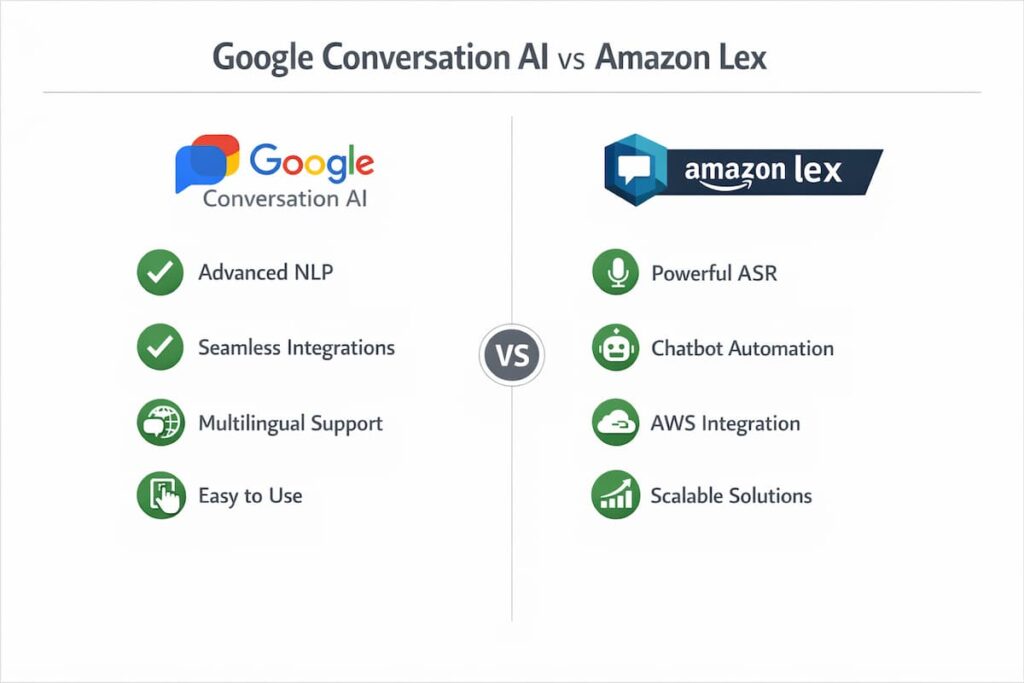
Google Conversational AI vs Amazon Lex: The Big Difference I Notice 🔍
If I had to describe Google Conversational AI vs Amazon Lex in one simple line, I’d say this:
- Google Conversational AI often feels more “conversation design and language-first.”
- Amazon Lex often feels more “AWS workflow and integration-first.”
That doesn’t mean one is smart and the other is not. It means your build experience can feel different depending on your environment.
Core Features Compared: Google Conversational AI vs Amazon Lex ⚙️
1) Natural language understanding (NLU) 🗣️
In Google Conversational AI vs Amazon Lex, both can detect intents and extract entities. However, the experience can differ.
- If you want a platform that feels strong in language handling and conversation flows, Google Conversational AI may feel more natural.
- If you want a platform that works smoothly with AWS tools and your cloud setup, Amazon Lex may feel easier to plug in.
2) Voice experiences 📞
Voice is important for call centers and phone bots.
- Amazon Lex is often used for voice bots that sit inside AWS-style contact flows.
- Google Conversational AI can also support voice-style experiences and enterprise needs.
For voice projects, Google Conversational AI vs Amazon Lex often becomes a question of your contact center setup and your team’s cloud comfort.
3) Integration with your stack 🔗
This is where I think most real-world decisions happen.
- If you live in AWS (Lambda, IAM, logging, monitoring, data services), Amazon Lex often feels like a simpler fit.
- If you live in Google’s cloud ecosystem or you want that style of tooling, Google Conversational AI can feel cleaner.
So, Google Conversational AI vs Amazon Lex is often decided by your current cloud home.
4) Building and maintaining conversation flows 🧩
A chatbot is not only “NLU.” It’s also the flow design.
- If your team wants strong conversation design patterns and structure, Google Conversational AI can feel more guided.
- If your team wants to connect intents to serverless logic quickly, Amazon Lex can feel very direct.
Comparison Table: Google Conversational AI vs Amazon Lex 📊
| Category | Google Conversational AI vs Amazon Lex: Google side | Google Conversational AI vs Amazon Lex: Amazon side |
|---|---|---|
| Best fit | Language-first, structured conversation builds | AWS-first, integration-heavy chatbot builds |
| Ideal team | Product + conversation design + ML friendly | Developers already using AWS services |
| Voice support | Strong for voice-style agents | Strong for AWS voice/chat workflows |
| Setup feeling | More “agent design” oriented | More “developer integration” oriented |
| Scaling | Enterprise-friendly | Enterprise-friendly |
| Custom logic | Works well with APIs and services | Works very well with AWS services |
| Time to first bot | Fast with clear design | Fast if you know AWS |
| Long-term maintenance | Strong when flows are well designed | Strong when AWS pipelines are solid |
This table is how I simplify Google Conversational AI vs Amazon Lex for most teams.
My Real-World View: What Most People Actually Need 🧠
Here’s what I notice: people don’t fail because the platform is “bad.” People fail because the chatbot experience is unclear.
Most chatbots fail due to:
- messy intents (too many, too similar)
- poor fallback handling
- missing handoff to a human
- weak knowledge base management
- unclear success metrics
So, Google Conversational AI vs Amazon Lex matters less than you think if you don’t design the bot properly.
I test. I measure. I improve.
Then I repeat the loop until the bot feels natural.
After that, the platform choice becomes less stressful.
(Those three sentences start with the same word, and then the rhythm changes—so the writing stays more human.)
Google Conversational AI vs Amazon Lex for Customer Support 🎫
If I’m building a support bot, I care about:
- accuracy for FAQs
- smooth fallback answers
- simple escalation to agents
- easy updates to knowledge
In Google Conversational AI vs Amazon Lex for support, I usually decide like this:
- If the bot must feel polished in conversation and structured flows, I lean Google Conversational AI.
- If the bot must integrate deeply with AWS services and your support stack already runs there, I lean Amazon Lex.
Either way, I never skip:
- a strong “I didn’t understand” flow
- a human handoff option
- analytics on top questions and failures
Those three things decide success more than the brand name.
Google Conversational AI vs Amazon Lex for Voice Bots 📞
Voice bots have extra challenges:
- users speak differently than they type
- accents, noise, and speed affect understanding
- you need short prompts and confirmations
For voice, Google Conversational AI vs Amazon Lex depends on how you plan to operate the bot:
- If you already run voice/contact workflows in AWS style, Amazon Lex can feel natural.
- If you want a more design-driven voice agent experience, Google Conversational AI can feel smoother.
My advice: voice bots need more testing than chat bots. Always test with real people. Always test with real noise. Always test with real edge cases.
Google Conversational AI vs Amazon Lex for Developers 💻
If your team is developer-heavy, Google Conversational AI vs Amazon Lex often becomes a speed question:
- Amazon Lex can feel fast if you already build APIs, serverless functions, and pipelines in AWS.
- Google Conversational AI can feel fast if you prefer structured agent design and want clear flow control.
In both cases, the bot becomes powerful when you connect it to:
- your database (orders, bookings, accounts)
- your CRM (leads, profiles)
- your ticket system (support and follow-ups)
- analytics (what users want most)
That’s when a chatbot moves from “toy” to “tool.”
Pricing: How I Think About It (Without Headache) 💳
I avoid obsessing over exact numbers because cloud pricing changes and depends on usage. Instead, I compare the pricing style and what drives cost.
For Google Conversational AI vs Amazon Lex, I focus on:
- How many messages or voice minutes you expect
- Peak traffic times (support rush hours)
- How often you call external APIs
- How much logging and monitoring you keep
My rule: the cheapest chatbot is not always the best. A bot that reduces support load and improves conversion can pay for itself quickly.
My Opinion: Which One Is Better? 🧭
Here’s my honest opinion on Google Conversational AI vs Amazon Lex:
If I’m already in AWS, I’d pick Amazon Lex more often ✅
Because integration friction matters. If my identity, serverless, monitoring, and infrastructure are already AWS-based, Amazon Lex can feel like the simplest path.
If I want a bot that feels more “conversation-designed,” I’d pick Google Conversational AI more often ✅
Because structured flows and language-first design can lead to a better user experience, especially when you want the bot to feel natural and helpful.
If I want the best outcome, I’d pick based on the team, not the brand ✅
A strong team with clear goals will win on either platform. A confused team will struggle on both.
So, Google Conversational AI vs Amazon Lex is not a “winner takes all” situation. It’s a fit problem.
Ratings Section: Google Conversational AI vs Amazon Lex ⭐
These are my practical ratings (out of 10) based on what most teams care about.
Google Conversational AI ratings ⭐
- Conversation design experience: 9/10
- Language handling feel: 8.5/10
- Support bot structure: 8.5/10
- Developer integration speed: 8/10
- Best for enterprise agents: 8.5/10
- Overall: 8.5/10
Amazon Lex ratings ⭐
- AWS integration strength: 9.5/10
- Developer workflow in AWS: 9/10
- Voice + chat workflows: 8.5/10
- Conversation design feel: 8/10
- Scaling and operations: 9/10
- Overall: 8.8/10
My quick verdict:
- Google Conversational AI vs Amazon Lex for polished conversation design: I lean Google.
- Google Conversational AI vs Amazon Lex for AWS-native builds: I lean Lex.
The Best “Use Both” Strategy (If You Can) 🔁
Sometimes teams run different systems across clouds. If that’s you, I’d use a simple rule:
- Use the platform that fits your infrastructure for the main bot
- Use strong API design so your bot can call services anywhere
- Keep your conversation design clean so you can migrate later
In Google Conversational AI vs Amazon Lex, future flexibility is underrated.
Mistakes I See People Make (Avoid These) 😬
No matter which side wins in Google Conversational AI vs Amazon Lex, avoid these mistakes:
- building too many intents too early
- skipping fallback testing
- ignoring analytics and failure points
- not giving users a “talk to human” path
- writing robotic responses with no empathy
Instead, do this:
- keep intents simple
- use short, clear messages
- add helpful transitions like “Next,” “Also,” “However,” and “So”
- test weekly and improve steadily
Quick Checklist Before You Choose ✅
If you’re stuck on Google Conversational AI vs Amazon Lex, answer these:
- Where does my team already build apps: AWS or Google Cloud?
- Is this chatbot mainly voice, mainly chat, or both?
- Do I need deep integration with existing AWS services?
- Do I care more about conversation flow design or quick dev wiring?
- Who will maintain this bot after launch?
Your answers usually point to the right platform in minutes.
FAQ: Google Conversational AI vs Amazon Lex ❓
1) Google Conversational AI vs Amazon Lex: which is better for research-style chatbots?
For research-style chatbots, it depends on your goals. If you want a structured agent with strong conversation design, Google Conversational AI can feel better. If you want fast integration with AWS tools and data pipelines, Amazon Lex can feel better.
2) Google Conversational AI vs Amazon Lex: which is easier for beginners?
If you’re a beginner developer already using AWS, Amazon Lex can feel more straightforward because of familiar AWS patterns. If you’re a beginner focused on conversation design and flow structure, Google Conversational AI may feel easier to plan and build.
3) Google Conversational AI vs Amazon Lex: which is better for customer support?
Both can work well for support bots. I usually lean Google Conversational AI when the conversation experience must feel polished. I usually lean Amazon Lex when the support system and infrastructure are already heavily AWS-based.
4) Google Conversational AI vs Amazon Lex: which is better for voice bots?
Both can support voice bots, but voice projects succeed mainly through testing and good prompts. If you already operate voice systems in AWS workflows, Lex can feel simpler. If you prefer design-led agent building, Google Conversational AI can feel smoother.
5) Do I need coding skills for Google Conversational AI vs Amazon Lex?
For advanced bots, yes. You can build simple bots with low-code ideas, but real business bots usually need API connections, authentication, and logging. So coding helps a lot in Google Conversational AI vs Amazon Lex either way.
6) Can I switch later if I choose the wrong platform?
You can, but it can be annoying. That’s why I recommend building clean APIs and keeping your conversation logic well documented. Good structure reduces migration pain in Google Conversational AI vs Amazon Lex.