

Claude better than ChatGPT for students is a topic I see everywhere, especially from people who take school seriously and want an AI tool that feels calm, organized, and “study-first.” I’ve used AI tools for learning, rewriting notes, preparing for tests, and fixing essays. Over time, I noticed something: some tools are great at speed and creativity, while others shine when you feed them long material and ask for clean, structured understanding.
This post is my point of view based on practical student needs: homework help, exam prep, note-making, writing, and understanding confusing topics. I’ll explain where Claude can feel better, where ChatGPT can feel better, and how to choose depending on your subject and study style. I’ll keep it simple, human, and helpful.
Also, I’m not trying to create fan wars. Students don’t need drama. Students need results. ✅
I tested both for summarizing notes. I tested both for explaining tough concepts. I tested both for creating quizzes.
Then I compared which tool saved more time.
After that, the strengths became clear.
Quick Answer: When Claude Better Than ChatGPT for Students? ✅
In my experience, Claude better than ChatGPT for students most often when you need:
- cleaner structure from long study material 📄
- calmer, less “random” writing style ✍️
- clear summaries and notes that feel organized 🧾
- careful tone for essays and formal writing 📝
- a “study partner” vibe that stays on track 🎯
ChatGPT can still be excellent for many tasks. However, the reasons students say Claude better than ChatGPT for students usually come from these “school workflow” moments.
1) Claude Handles Long Notes and Big PDFs Smoothly 📚
One big reason Claude better than ChatGPT for students is how it feels when you paste long material. Students often work with:
- long lecture notes
- textbook chapters
- research articles
- full assignment instructions
Claude usually does a strong job at:
- keeping the structure
- summarizing without losing the point
- giving a clean outline
- staying consistent from top to bottom
If you’re the kind of student who dumps a big chapter and says “help,” this is a key advantage.
What I like to ask Claude:
- “Turn this chapter into short notes with headings.”
- “Give me key definitions + 3 examples.”
- “Make an exam-style summary and a revision sheet.”
This is where Claude better than ChatGPT for students becomes a real time-saver.
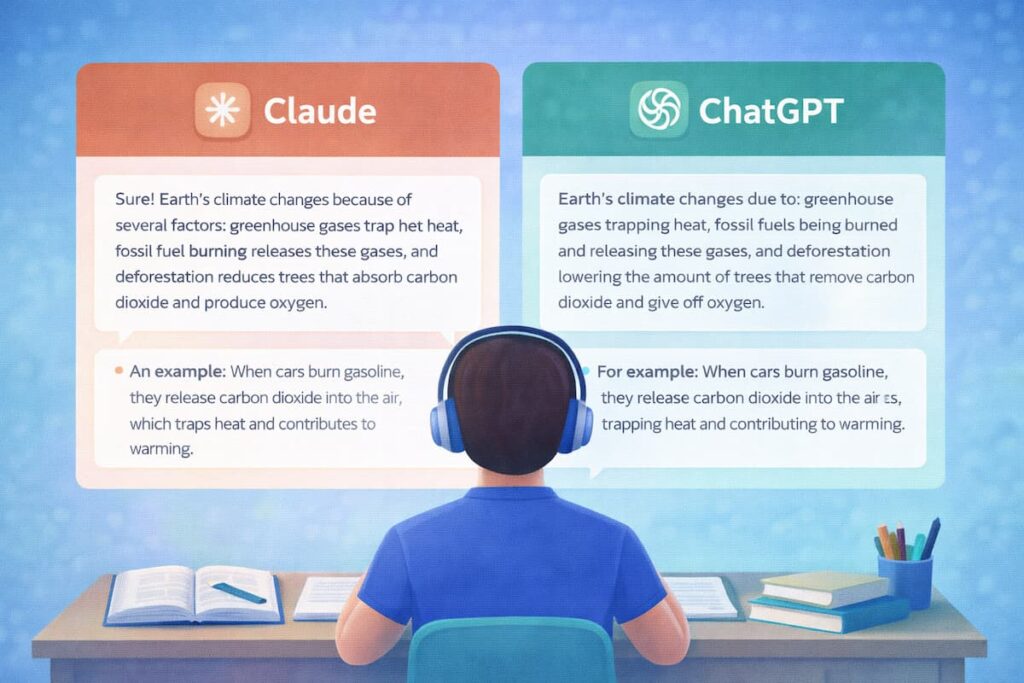
2) Claude Feels More “Study-First” in Tone 🧠
Some tools give answers that feel energetic or creative. That’s not bad. But in school, you often want:
- calm explanations
- direct answers
- fewer tangents
- clean formatting
Claude often feels like it’s trying to be a tutor who stays focused. For students who get distracted easily, that’s huge.
Also, Claude’s writing style often sounds less “salesy” and more like notes you’d actually use.
3) Better Summaries That Look Like Real Notes 📝✨
Claude better than ChatGPT for students especially in note-making. A good summary should:
- keep the main idea
- include key terms
- include examples
- show relationships (cause → effect)
- be quick to revise later
Claude often outputs:
- clearer headings
- consistent bullets
- less repeated filler
Study trick:
Ask for a “two-layer summary”:
- Layer 1: 10 bullet points (quick review)
- Layer 2: 10 short explanations (deeper review)
That method boosts memory without extra studying.
4) Claude Is Strong for Writing Help Without Over-Complicating ✍️
Students write:
- essays
- lab reports
- emails to professors
- research summaries
- scholarship statements
Claude often helps by:
- keeping sentences smooth and simple
- improving clarity without making it “robotic”
- maintaining formal tone naturally
ChatGPT is also strong at writing. Still, in my view, Claude sometimes feels more consistent for academic tone.
Prompts that work well:
- “Rewrite this in simple, formal academic English.”
- “Improve clarity but keep my meaning.”
- “Fix grammar and explain the changes.”
5) Claude Often Organizes Information Better 🧩
Claude better than ChatGPT for students when you need structure. For example:
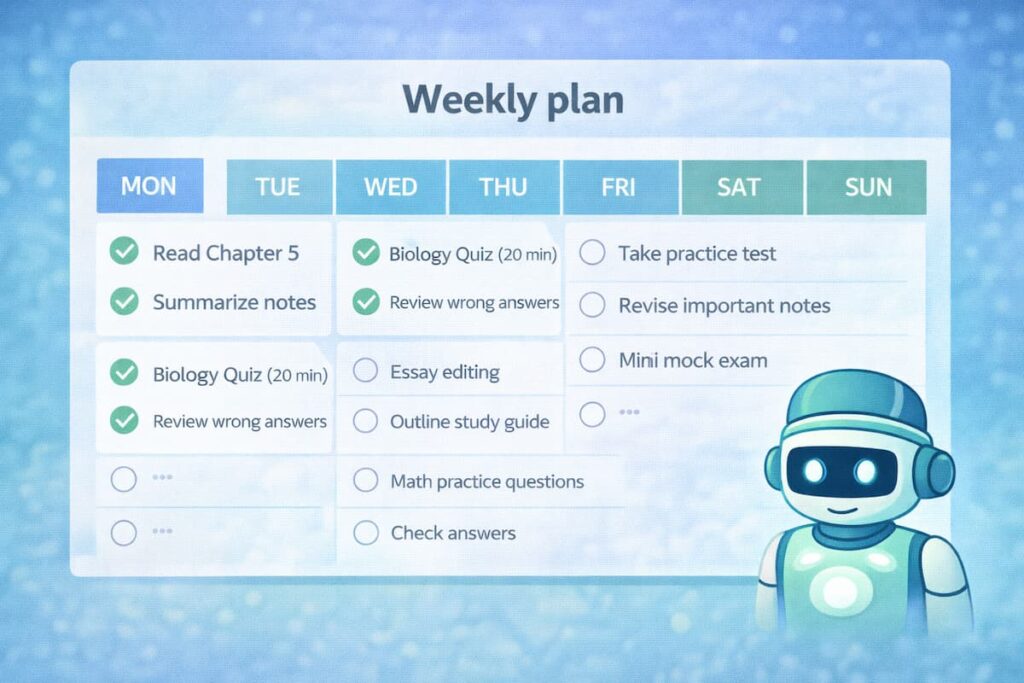
- study plan for 2 weeks
- topic breakdown into micro-lessons
- revision schedule with spaced repetition
- checklist for an assignment
Claude often gives more “teacher-style” organization:
- headings → subheadings → bullet points
- clear next steps
- less jumping around
This is not always true, but it’s common enough that students notice it quickly.
6) Claude Can Be Great for “Explaining Like I’m 12” 🧒📘
When you’re stuck, you don’t need a high-level answer. You need simple language.
Claude often does well when you ask:
- “Explain in short sentences.”
- “Use simple words.”
- “Give a real-life analogy.”
ChatGPT can do this too. But Claude’s default tone often feels more gentle and less “over-confident,” which helps learning.
7) Where ChatGPT Can Be Better for Students ⚖️
To stay unbiased: ChatGPT is excellent in many student scenarios.
ChatGPT can feel better when you need:
- step-by-step tutoring with lots of examples ➗
- fast brainstorming (ideas, outlines, topics) 💡
- creative study hacks and mnemonics 🎯
- coding help and debugging 💻
- interactive Q&A style practice (roleplay teacher) 👨🏫
So even if Claude better than ChatGPT for students in some areas, ChatGPT can still win in others depending on what you study.
Comparison Table: Claude vs ChatGPT for Students 📊
| Student Task | Claude | ChatGPT |
|---|---|---|
| Summarizing long notes | Strong, clean structure | Strong, can vary by style |
| Turning chapters into study sheets | Very organized | Great, sometimes more detailed |
| Explaining tough concepts simply | Calm, clear | Very flexible, can be very detailed |
| Essay rewriting (academic tone) | Consistent and natural | Powerful, sometimes more “polished” |
| Brainstorming ideas | Good | Often excellent |
| Practice questions & quizzes | Good | Excellent, very adaptable |
| Coding help | Good | Often excellent |
| Study planning | Structured, tidy | Strong, customizable |
This table is the simplest way I explain Claude better than ChatGPT for students without bias.
Subject-Wise: When Claude Better Than ChatGPT for Students? 🎓
English / Writing ✍️
Claude better than ChatGPT for students when the goal is clean academic writing and calmer tone.
Best uses:
- rewrite essays
- improve clarity
- fix grammar with minimal change
History / Social Studies 🏛️
Claude is great when you paste long chapters and want:
- timelines
- key events
- cause/effect summaries
Biology / Theory-heavy Science 🔬
Claude can produce:
- neat notes
- processes
- definitions + examples
Math / Physics ➗
I often lean slightly toward ChatGPT for:
- step-by-step solving
- multiple approaches
- practice question generation
Computer Science 💻
Both can help a lot. ChatGPT can feel stronger in debugging and code explanations, but Claude can be excellent for organizing project requirements and documentation.
My Opinion: What I’d Use as a Student (Real Workflow) 🗣️
Here’s my honest workflow opinion.
If I had to pick one “default” study assistant, I’d choose based on the task:
- For long notes, summaries, and clean academic tone → Claude
- For practice questions, step-by-step tutoring, and brainstorming → ChatGPT
So yes, Claude better than ChatGPT for students in many note-heavy and writing-heavy scenarios. But I wouldn’t say ChatGPT is worse overall. It’s more like:
- Claude = calm organizer
- ChatGPT = flexible problem-solver
If you can use both, even better:
- Claude makes clean notes
- ChatGPT turns notes into quizzes and mocks
That combo feels powerful.
Ratings (Student-Focused, Not Biased) ⭐
Claude (for students)
- Long notes & summaries: 9.2/10
- Academic writing tone: 9.0/10
- Organization & structure: 9.1/10
- Practice questions: 8.4/10
- Overall student value: 8.9/10
ChatGPT (for students)
- Explanations & tutoring: 9.1/10
- Practice questions & quizzes: 9.2/10
- Brainstorming & creativity: 9.3/10
- Long-note structure: 8.6/10
- Overall student value: 9.0/10
These scores are close because both tools are strong. The difference is the “feel” and workflow.
How to Get Better Results (Simple Prompt Templates) 🧾✅
For Claude (notes + study sheets)
- “Summarize this into headings + bullet points. Add 5 key definitions and 3 examples.”
- “Make a one-page revision sheet and then 15 quiz questions.”
For ChatGPT (practice + tutoring)
- “Teach me this step-by-step like a tutor. Give 10 practice questions and check my answers.”
- “Create a mock test and mark it strictly.”
Using the right prompt is how you truly unlock Claude better than ChatGPT for students in real life.
Common Mistakes Students Make With AI 😬
Avoid these:
- copying answers without understanding
- using AI summaries but never self-testing
- not checking mistakes
- asking vague questions like “explain this” with no context
Better habit:
- ask → learn → test → correct → revise
That loop builds real memory.
FAQ: Claude Better Than ChatGPT for Students ❓
1) Is Claude better than ChatGPT for students overall?
Claude better than ChatGPT for students mainly for long notes, structured summaries, and academic-tone writing. However, ChatGPT can be better for step-by-step tutoring, quizzes, and brainstorming. It depends on your study task.
2) Which one is better for exam preparation?
If your exam needs heavy revision notes, Claude is excellent. If your exam needs lots of practice questions, ChatGPT can feel stronger. Ideally, use Claude for notes and ChatGPT for quizzes.
3) Which AI is better for essays and assignments?
Claude often feels more consistent for academic tone and clarity. ChatGPT is also strong, especially if you give clear instructions and examples of your style.
4) Can these tools give wrong answers?
Yes, both can make mistakes. The safest method is to use AI for learning support, then verify important facts and always practice with questions to confirm understanding.
5) How can I use AI without cheating?
Use AI for explanations, practice questions, feedback, and planning. Write your own final work. If you use help for structure, still make sure the ideas and final writing are yours.
6) What’s the best daily routine for students using AI?
A simple routine:
- 10 minutes: AI explains + examples
- 25 minutes: practice questions
- 15 minutes: review mistakes + summary notes
This makes learning faster without studying more hours.